
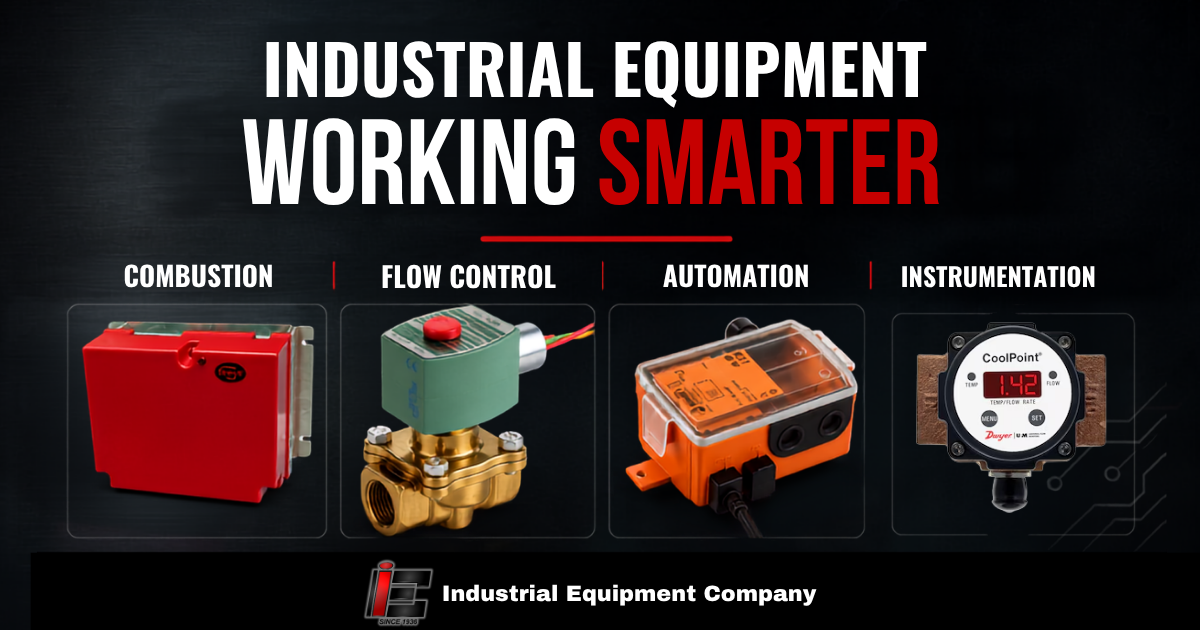
Industrial Equipment: Working Smarter
Across industrial facilities, some of the biggest advances are happening in equipment that has been doing essential work for decades: controlling combustion, moving fluids, automating mechanical systems, and measuring what is happening inside a process.
What is changing is how much intelligence is being built into those systems. Better diagnostics, more precise control, and greater visibility into operating conditions are giving engineers, operators, and maintenance teams more information and better opportunities to address issues before they become problems.
Here are four areas where we are seeing that evolution among our manufacturers:
Combustion: More Intelligence Behind the Flame
Combustion safety will always begin with one fundamental requirement: knowing when a flame is present and safely shutting the system down when it isn’t. But today’s combustion technology can do considerably more.
Fireye continues to expand beyond traditional flame safeguard into more comprehensive combustion management. In 2026, Fireye acquired Energy Technology & Control, a company specializing in industrial combustion-control technology. The acquisition further expands Fireye’s capabilities in combustion optimization and control.
For facilities operating boilers, furnaces, ovens, and other fired equipment, that evolution matters. Better information about combustion conditions can help operators diagnose problems, manage equipment more effectively, and improve overall system performance while maintaining the safety functions that remain critical to the process.
The objective isn’t technology for technology’s sake. It is giving the people responsible for fired equipment better information about what the system is actually doing.
Flow Control: Small Component, Major Responsibility
Solenoid valves can be relatively small components in an industrial system, but the job they perform can be critical. When a process calls for a liquid or gas to start, stop, or change direction, the valve has to respond correctly and reliably.
ASCO has built its fluid-control portfolio around applications involving industrial automation, process control and fluid management. Its solenoid valves control media including water, air, gases, and other fluids across a wide range of industrial applications.
That makes flow control an important part of the “working smarter” conversation. Reliability remains essential, but today’s facilities are also focusing on efficiency, response, integration, and selecting the right valve for the application’s pressure, media, environment, and operating requirements.
A valve may only be one component in a much larger system. When it doesn’t perform as expected, however, the effects can extend well beyond that single component.
Automation: More Visibility at the Point of Control
Automation becomes useful when a control decision actually produces the correct physical response. That makes actuators and other field devices a critical connection between the control system and the mechanical equipment.
Belimo’s current generation of HVAC field devices illustrates how that relationship is evolving. Connected actuators can incorporate digital configuration, diagnostics, and communication capabilities that provide considerably more information than traditional field devices. Belimo’s newest GM damper actuator, for example, includes guided setup, intelligent diagnostics, and NFC functionality, while the company says it can reduce power consumption at rest by as much as 75%.
For technicians and facility teams, the practical value is visibility. Instead of automation simply issuing a command, modern field devices can provide more information about how that command is being executed.
That can make commissioning easier, troubleshooting faster, and equipment performance easier to understand.
Instrumentation: Better Decisions Start With Better Measurement
You cannot effectively control a process without knowing what is happening inside it. That is why flow, pressure, temperature, and level measurement remain fundamental to industrial operations.
The DwyerOmega CoolPoint® Vortex Shedding Flowmeter is a good example of how even established measurement technologies continue to become more practical. The CoolPoint series measures water, water/glycol mixtures, and other low-viscosity fluids using vortex-shedding technology. Because the measurement system has no moving parts, the design offers low maintenance and low pressure drop. Applications include hydronic heating and cooling systems, chilled-water loops, and process-water measurement.
The important part isn’t simply displaying a flow rate on a screen.
Reliable flow information gives operators another piece of the process picture. It can help confirm that equipment is receiving the flow it requires, identify abnormal operating conditions, and provide the information needed to make better control and maintenance decisions.
The smarter the system becomes, the more important accurate measurement becomes.
Smarter Equipment Still Requires the Right Application
Combustion controls can provide more information. Valves can deliver more precise fluid control. Connected actuators can improve visibility. Instrumentation can give operators a clearer picture of what is happening throughout the process.
But none of those capabilities replace proper product selection.
The media being controlled, operating pressure, temperature, environment, electrical requirements, safety classification, existing equipment, and intended application still determine whether a product is actually the right solution.
That has been Industrial Equipment Company’s role since 1936: helping customers understand the technologies available from leading manufacturers and determine what makes sense for the equipment and process in front of them. We can do the same for you. Visit Indeco-tx.com to find the location near you.